
District Heating and District Cooling Heat Exchanger Solutions with BPHE and GPHE
Efficient thermal transfer for district energy substations, building interfaces, HVAC networks, and urban heating and cooling systems through compact brazed plate heat exchangers and serviceable gasketed plate heat exchangers.
Why Heat Exchangers Are Critical in District Heating and District Cooling
District heating and district cooling networks rely on efficient and reliable heat transfer between the central energy source and the end-user building or process. In most cases, the heat exchanger is the key interface that separates the primary network from the secondary building loop while transferring energy with minimal temperature loss and strong operational stability.
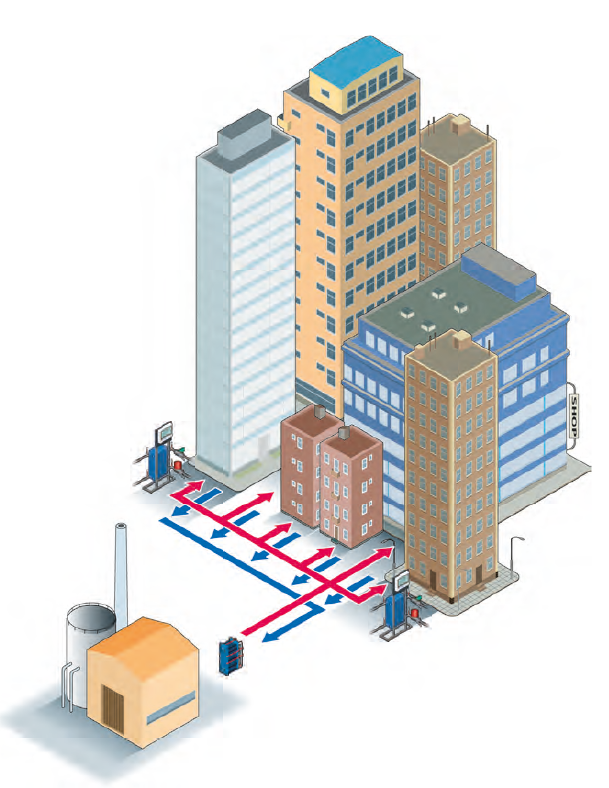
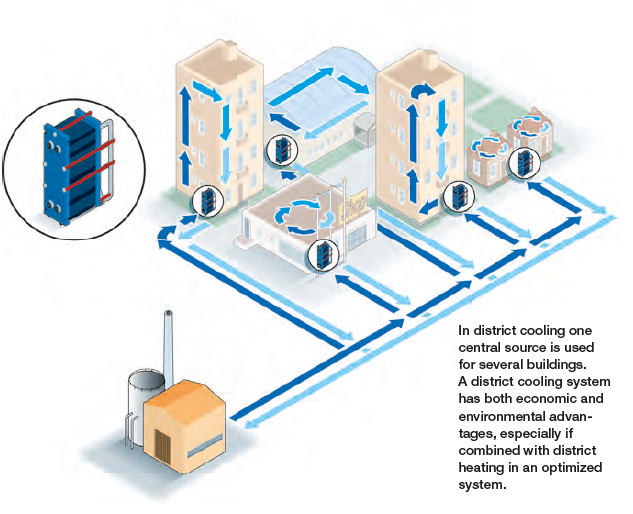
In district heating systems, hot water from a municipal or campus-wide network is transferred to the building heating circuit, domestic hot water circuit, or process heating loop. In district cooling systems, chilled water from the central plant is transferred to the building-side cooling system for air conditioning, process cooling, or comfort cooling. In both cases, plate heat exchangers are widely preferred because they offer compact size, high efficiency, fast thermal response, and flexible integration into substations and energy transfer stations.
How a District Energy Heat Exchanger Works
A district heating or district cooling heat exchanger usually sits inside an energy transfer station, heat interface unit, or building substation. The primary side is connected to the district network. The secondary side is connected to the building or facility loop. Heat is transferred through the plates without mixing the two fluids.
Typical District Heating and Cooling Applications
Building Substations
District heating substations use plate heat exchangers to transfer heat from the primary network to radiators, floor heating, fan coil units, or domestic hot water preparation systems.
District Cooling Interfaces
Chilled water networks often use plate heat exchangers to separate central district cooling water from the secondary building cooling circuit, reducing contamination risk and simplifying control.
Energy Transfer Stations
Compact plate heat exchangers are widely used in ETS packages where space is limited and high thermal efficiency is essential for heating and cooling transfer.
Domestic Hot Water Systems
Brazed plate heat exchangers are commonly selected for instantaneous domestic hot water generation in district heating systems because of their compact size and strong performance.
Commercial HVAC Networks
Office buildings, hospitals, campuses, hotels, and mixed-use developments use plate heat exchangers to connect district energy to internal HVAC loops safely and efficiently.
Industrial and Campus Utility Systems
District thermal systems on campuses and industrial parks often require robust GPHE or compact BPHE solutions depending on scale, cleanliness, and maintenance requirements.
BPHE vs GPHE for District Heating and District Cooling
For this application, the two most relevant technologies are brazed plate heat exchangers and gasketed plate heat exchangers. Both are highly effective for district energy systems, but they serve different operating conditions, capacities, and maintenance philosophies.
BPHE – Brazed Plate Heat Exchangers
BPHE units are especially suitable for compact district heating substations, domestic hot water modules, apartment-level heat interface units, and smaller building connections where high efficiency, small footprint, and low installed volume are priorities. They are often selected when the media are clean and a sealed compact unit is preferred.
GPHE – Gasketed Plate Heat Exchangers
GPHE units are ideal for larger district energy substations, district cooling interfaces, commercial HVAC transfer stations, and systems where inspection, cleaning, maintenance, or future capacity expansion are important. They offer flexibility, openability, and excellent performance for larger flows and more serviceable installations.
| Factor | BPHE | GPHE |
|---|---|---|
| Typical Project Size | Small to medium substations, HIU, DHW modules | Medium to large district transfer stations and HVAC interfaces |
| Maintenance Access | Sealed unit, normally not openable | Openable for inspection, cleaning, and service |
| Footprint | Very compact | Compact, but larger than BPHE at similar duty |
| Cleanliness Requirement | Better for cleaner media and controlled water quality | Better when fouling risk or maintenance need is higher |
| Capacity Expansion | Fixed design | Possible to adjust plate pack in many cases |
| Typical Use in District Systems | Apartment stations, compact heating skids, DHW generation | Building substations, district cooling plants, commercial ETS |
Why Plate Heat Exchangers Are Preferred in District Energy Systems
- High thermal efficiency with small approach temperature.
- Compact footprint for crowded mechanical rooms and substations.
- Fast response to fluctuating building heating or cooling demand.
- Low hold-up volume compared with bulkier exchanger designs.
- Excellent fit for modular and skid-mounted energy transfer stations.
- Strong separation between primary network and secondary building loop.
- Flexible use in heating, cooling, and domestic hot water applications.
- Better serviceability with GPHE where maintenance matters.
- Excellent compact solution with BPHE where space is limited.
- Suitable for modern district energy systems focused on efficiency and controllability.
Key Design Considerations for District Heating and Cooling Heat Exchangers
| Design Factor | Why It Matters | Typical Impact |
|---|---|---|
| Primary and Secondary Temperatures | District systems often target tight approach temperatures for better energy efficiency. | Affects plate pattern, exchanger size, and achievable outlet temperatures. |
| Flow Rate | Building demand and network conditions determine hydraulic sizing. | Directly influences pressure drop and plate area requirement. |
| Pressure Class | District networks can operate at elevated pressures compared with building loops. | Determines mechanical design and product selection. |
| Water Quality | Water chemistry and fouling tendency strongly affect long-term reliability. | May drive the choice between BPHE and GPHE. |
| Maintenance Philosophy | Some operators want sealed compact modules; others require cleaning access. | Important for selecting compact brazed versus openable gasketed design. |
| Load Variation | Heating and cooling demand varies by season, occupancy, and weather. | Heat exchanger selection should consider partial-load performance as well as peak demand. |
| Space Limitation | Mechanical rooms and ETS skids often have limited installation space. | Favors compact plate heat exchanger designs. |
Water Quality, Materials, and Reliability
District heating and district cooling loops are usually water-based, but actual water chemistry can vary significantly from project to project. Corrosion potential, oxygen content, suspended solids, scaling tendency, and system cleanliness all influence heat exchanger life and performance.
In well-controlled clean systems, BPHE can be an excellent long-term solution for compact stations. In larger systems or where fouling, maintenance, or inspection access is important, GPHE often provides better operational flexibility. Proper material selection and realistic fouling consideration are both essential to reliable district energy performance.
Related Heat Exchanger Knowledge and Product Pages
District heating and district cooling are closely related to broader HVAC, utility, and energy transfer applications. To explore the most relevant technologies and adjacent topics, you can also review Brazed Plate Heat Exchangers, Gasketed Plate Heat Exchangers, Heat Recovery Systems, Renewable Energy Heat Exchanger Applications, Energy Storage Cooling, and Power Generation Heat Exchanger Systems.
FAQ: District Heating and District Cooling Heat Exchangers
What heat exchanger is commonly used in district heating systems?
Is BPHE suitable for district heating substations?
When is GPHE better than BPHE in district cooling or district heating?
Why are plate heat exchangers preferred over bulkier alternatives in district energy?
What information is needed to size a district heating or cooling heat exchanger?
Conclusion: BPHE and GPHE Are the Core Heat Exchanger Choices for District Energy
District heating and district cooling systems demand efficient, compact, and reliable heat transfer between primary utility networks and secondary user loops. In these applications, plate heat exchangers are often the best engineering choice because they combine strong thermal performance with a practical installation footprint.
For compact stations and clean media, BPHE is often the preferred solution. For larger substations, district cooling interfaces, and systems where serviceability matters, GPHE is usually the stronger long-term option.


