In heat exchanger design, the basic equation is:
When the logarithmic mean temperature difference (LMTD) becomes very small, the heat transfer driving force nearly disappears.
For example:
| Hot Side | Cold Side |
|---|---|
| 30 → 10°C | 8 → 28°C |
At this level, the system is approaching the thermodynamic limit.
Any heat exchanger must compensate for the lack of temperature driving force by increasing either:
U – overall heat transfer coefficient
A – effective heat transfer area

Shell & tube heat exchangers typically have:
| Parameter | Typical Value |
|---|---|
| U value | 300–800 W/m²·K |
| Minimum approach ΔT | 8–15 K |
When LMTD falls below 5 K, shell & tube units must rely almost entirely on surface area.
The result is exponentially increasing size, weight, and cost.
For the same duty at ΔTlm = 2K:
This is why shell & tube units become impractical for low-grade heat recovery.
Plate heat exchangers (PHE) achieve:
| Parameter | Typical Value |
|---|---|
| U value | 2000–6000 W/m²·K |
| Minimum approach ΔT | 1–3 K |
The secret lies in:
Corrugated plates
High shear, turbulent micro-channels
Very thin thermal boundary layers
This allows PHEs to maintain high U values even when ΔT is extremely small.
If a PHE is simply made wider:
Flow velocity decreases
Turbulence weakens
Heat transfer coefficient drops
So instead, engineers design PHEs to be:
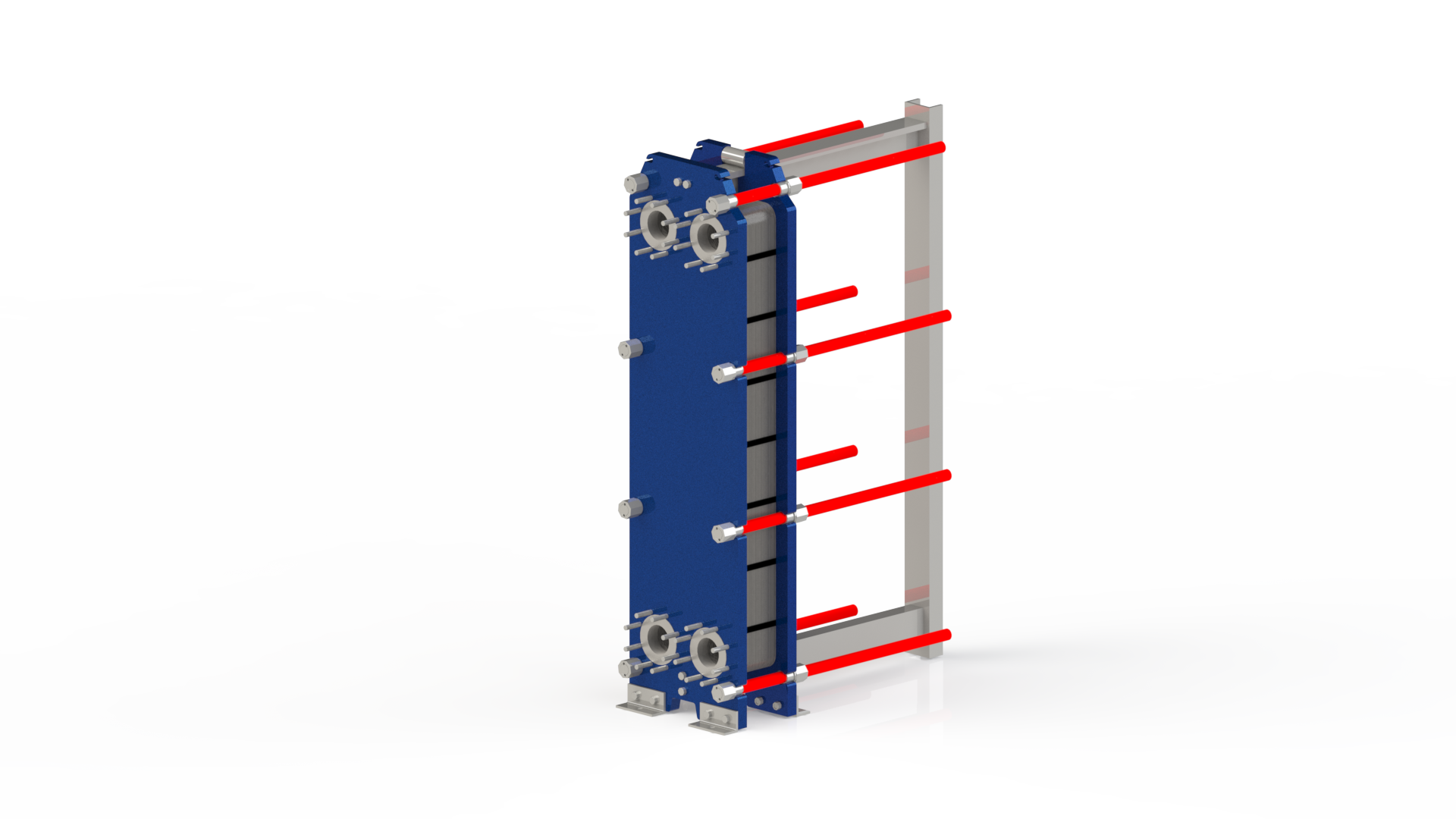
Long and narrow, not wide and short
This ensures:
High velocity
Strong turbulence
Stable U value
The long flow path also increases the NTU (Number of Transfer Units), which is essential when ΔT is small.
Multi-pass configurations force the fluid to:
Repeatedly change direction
Increase internal velocity
Extend effective contact time
This dramatically increases the convective heat transfer coefficient and allows the exchanger to operate closer to the thermodynamic limit.
| Feature | Engineering Purpose |
|---|---|
| Long plate design | Increase NTU and effective heat path |
| Narrow flow channels | Maintain velocity and turbulence |
| Multi-pass arrangement | Increase U value under low ΔT |
| High pressure drop | Acceptable trade-off for heat recovery |
Small temperature difference is not a design problem – it is a thermodynamic limitation.
Plate heat exchangers overcome this limitation by using fluid dynamics to amplify heat transfer.
Long, narrow, multi-pass plate heat exchangers are therefore not a design choice, but an engineering necessity for low-grade heat recovery.