In plate heat exchangers (BPHEs), especially when operating as evaporators, the way fluid is distributed at the inlet has a major impact on performance. Uneven distribution can lead to poor heat transfer, unstable operation, and reduced system efficiency.
To address this challenge, Alfa Laval developed a patented inlet distribution concept known as the Equalancer system. This technology is integrated directly into the heat exchanger plates and is designed to stabilize and equalize refrigerant flow before it enters the main plate channels.
In evaporator applications, the working fluid typically enters the heat exchanger as a two-phase mixture (liquid + vapor). Without proper distribution:
Some channels may receive too much vapor and too little liquid
Other channels may flood with liquid
Local dry-out and excessive superheating can occur
Heat transfer efficiency becomes uneven across the plate pack
These effects reduce the effective heat transfer area and can negatively impact compressor stability and overall system reliability.
The Equalancer system is not a separate mechanical distributor. Instead, it is a pressed geometric structure formed directly in the heat exchanger plate, near the inlet port.
Its purpose is to condition the incoming flow so that each plate channel receives a similar mixture quality and mass flow rate.
Key design objectives of the Equalancer system include:
Stabilizing two-phase flow
Promoting controlled re-mixing of liquid and vapor
Reducing jet effects at the inlet
Improving repeatability from plate to plate
Although compact, the Equalancer consists of several distinct functional elements:
Inlet circular cavity
Receives the incoming refrigerant from the connection port.
Small guiding orifices
Control how the fluid enters the distribution structure and limit direct high-velocity jets.
Crescent-shaped (half-moon) channel
The core of the Equalancer design.
Forces the fluid to follow a curved path
Encourages phase interaction and redistribution
Smooths velocity differences between liquid and vapor
Exit orifice
Releases the conditioned flow toward the main plate flow field.
All these features are formed as part of the plate pressing process, ensuring high dimensional accuracy and consistency.
In evaporator operation, the flow process can be summarized as follows:
Two-phase refrigerant enters the inlet circular cavity.
The fluid passes through a small orifice into the Equalancer structure.
Inside the crescent-shaped channel, the fluid follows a curved path, promoting:
Secondary mixing
Phase redistribution
Reduction of local velocity peaks
The flow exits through another small opening.
The conditioned refrigerant is then distributed into the plate channels more evenly.
This double-mixing effect significantly reduces channel-to-channel imbalance.
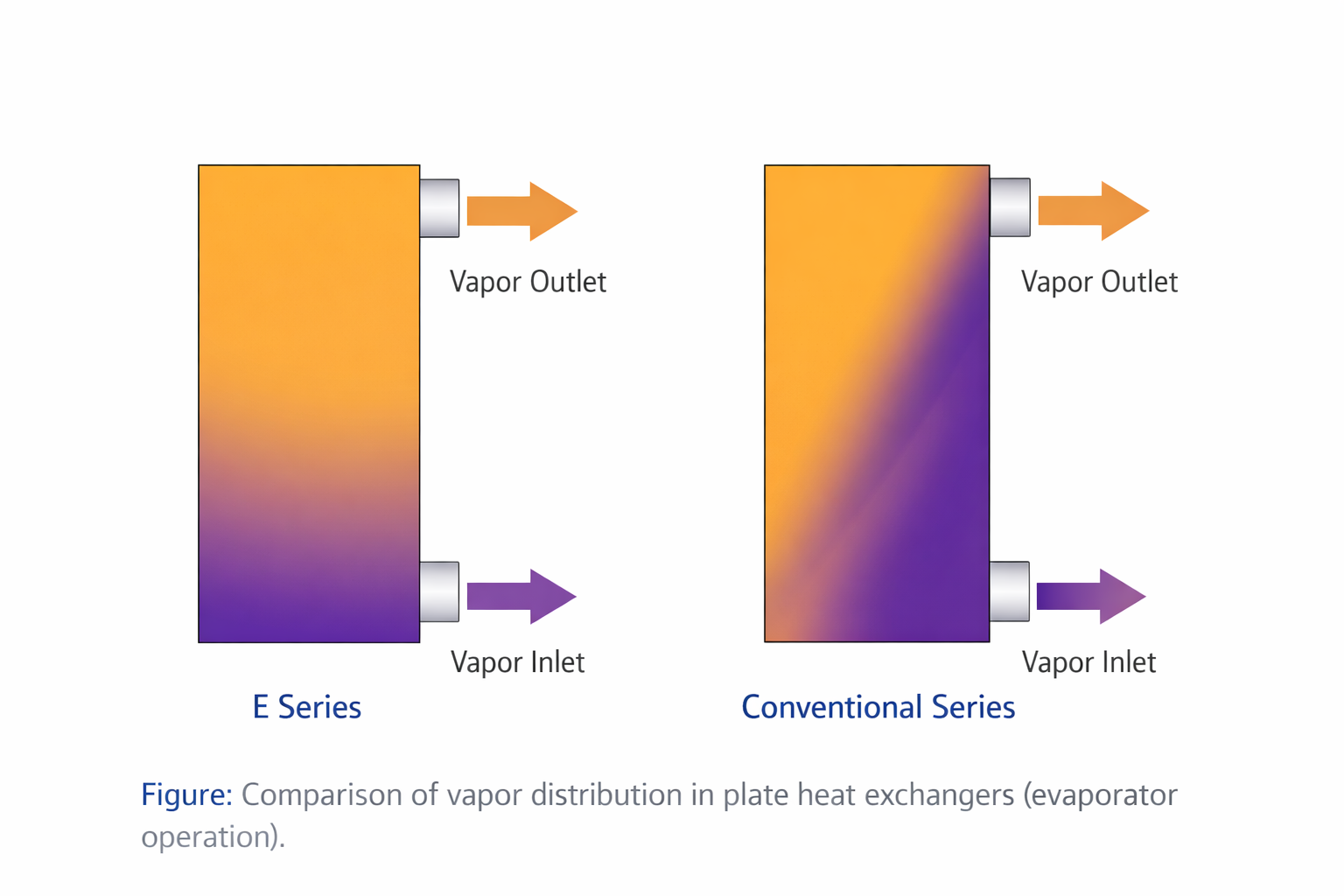
The Equalancer system provides several important advantages:
Improved evaporator efficiency
More uniform refrigerant distribution
Reduced superheating variations
Better utilization of heat transfer surface
Stable operation
Less sensitivity to inlet quality variations
Improved system controllability
Negligible impact in condenser mode
Pressure drop introduced by the Equalancer is minimal
No negative effect when the unit operates as a condenser
Manufacturing and reliability benefits
No additional components
Fully integrated into the plate
High repeatability and robustness
Suitable for high-volume production
| Aspect | Conventional Inlet Design | Equalancer System |
|---|---|---|
| Distribution method | Port geometry only | Plate-integrated distribution |
| Two-phase stability | Limited | High |
| Channel flow uniformity | Inconsistent | Highly consistent |
| Additional components | Sometimes required | None |
| Manufacturing repeatability | Moderate | Very high |
The Equalancer system used in Alfa Laval brazed plate heat exchangers is a subtle but critical design feature. By using carefully engineered plate embossing geometry, it achieves effective two-phase flow conditioning in a very small space.
Rather than relying on external distributors or complex assemblies, the Equalancer demonstrates how advanced plate design can significantly improve heat exchanger performance, stability, and reliability, especially in demanding evaporator applications.